
Passover Activities for Kids in Los Angeles and the Eight Days Families Actually Have to Fill
Los Angeles families have been navigating this particular stretch for generations. The weather cooperates sometimes. The seders are full and loud, the table extends into the hallway, the children perform the four questions with varying degrees of accuracy and maximum enthusiasm. And then morning comes and there is a week of break ahead, and no chametz in the house, and children who have already eaten their weight in macaroons and want to know what happens next.
What happens next is the subject of this article. Not the seders — those are handled. The days between. The activities, the events, the places that hold children well during Passover week in LA. Organized by age range because that distinction actually matters, and rounded out with the practical notes that save afternoon plans from falling apart.
Passover in Los Angeles and the Shape of the Holiday Week
Passover in Los Angeles falls in the spring, which sounds like an advantage. The weather is mild, parks are accessible, and the city has a large enough Jewish community that the holiday has genuine cultural presence — kosher restaurants run Passover menus, community centers host seder programming, and the general awareness of the holiday is higher than in most American cities.
The complication is that eight days is a long time, and the Passover schedule in LA often runs across two distinct phases. The first two and last two days carry more of the holiday's observance; the intermediate days — chol hamoed — are the ones where families have the most flexibility and the most need for actual plans. Jewish day schools and many synagogue preschools are fully out of session for the week. Public school calendars vary, but spring break often overlaps partially with Passover, which means siblings on different schedules trying to occupy the same space.
The communities anchoring Jewish Los Angeles — the Pico-Robertson corridor, Beverlywood, Hancock Park, Westwood, Brentwood, and the westside neighborhoods out through Santa Monica — each have their own density of programming and familiar venues. Families in Santa Monica often lean toward westside options for the week rather than cross-city drives. The distance calculus is real, and most practical Passover plans account for it.
Passover Events Los Angeles Families Look For Each Spring
Passover events los angeles runs across a spectrum — from the enormous community seder programs hosted by major synagogues and the JCC to small neighborhood drop-in activities at local Jewish preschools. The question of what to look for depends heavily on what a family is trying to do: communal experience, structured programming for children, or simply somewhere to go on a Tuesday afternoon in the middle of the break.
Large community seders happen at multiple venues across the city — the Wilshire Boulevard Temple, Chabad of Beverly Hills, and various federation-affiliated programs host seders that draw hundreds and are designed to be accessible to children who haven't sat through a traditional three-hour service. These are usually ticketed events that fill well in advance. Families who want a communal seder outside the home should be looking at reservations four to six weeks out at minimum.
During chol hamoed, the Jewish Federation of Greater Los Angeles and affiliated organizations typically run programming specifically for families — museum days, park gatherings, free or subsidized events designed around the holiday's themes of freedom and nature. The year-to-year calendar shifts, and the best source of current programming is always the federation's event listings or the specific synagogue and JCC newsletters rather than any published general guide.
Museums in LA are worth noting specifically during Passover week. The Los Angeles County Museum of Art and the Natural History Museum don't close for the holiday, and they carry a kind of accessible, low-structure visit that works well during the break days. The California Science Center runs through the same period. These aren't Passover-themed experiences, but they give families somewhere substantive to go without requiring any advance planning beyond showing up.
The indoor play option sits alongside all of this as the afternoon anchor rather than the day's main event. Fun Play World on West Pico Boulevard — which is squarely within the Pico-Robertson neighborhood, one of the densest Jewish communities in Los Angeles — runs Open Play every day of the week, and Passover week doesn't change that schedule. Families who observe chol hamoed without the restrictions of the holiday days can walk in, spend two hours in the play area, and return home with children who are meaningfully tired in a way that makes the evening calm.
Passover Activities for Preschoolers That Hold Without Much Setup
Passover activities for preschoolers are one of the easier planning problems of the holiday week, practically speaking — not because preschoolers are easy, but because they don't require complex programming. The bar for engagement at this age is sensory and physical. Did they touch something? Did they move? Did they make something they could hold?
The ten plagues are, somewhat counterintuitively, among the most accessible Passover content for very young children. The dramatic quality of the imagery — frogs, locusts, darkness — holds attention in a way that abstract freedom narratives don't. Simple craft versions of the plagues exist in every Jewish early childhood curriculum: cotton ball hail, handprint frogs, "darkness" collages with black paper and a flashlight. The activity works for three-year-olds in a way that the longer seder text simply doesn't.
Parsley dipping — tasting the bitter herbs, dipping in salt water, the sensory richness of the seder plate — is its own activity for this age. A dedicated "seder tasting" session earlier in the Passover week, with a small seder plate set up on a child-height table, gives preschoolers hands-on interaction with the holiday's physical objects before the actual seder overwhelms them with timing and adult expectations.
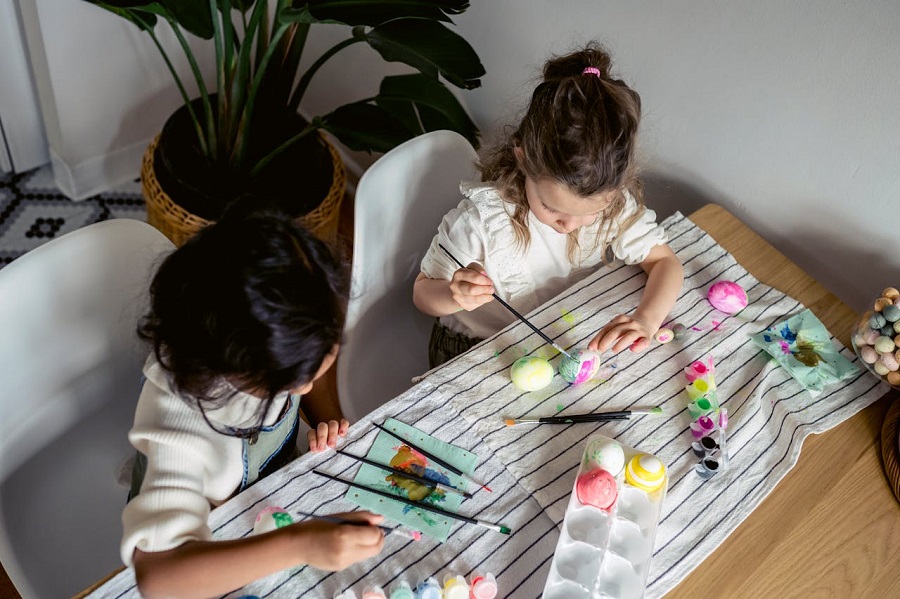
Matzah painting is a consistent hit, too. Matzah covered in cream cheese and a variety of toppings becomes both a craft project and a snack, which is a rare combination that preschoolers reliably endorse.
For the movement side of passover activities for preschoolers, the holiday week's school break means children need more physical outlet than usual — they don't have the classroom's built-in rhythm to manage their energy for them. Parks work in the morning when it's cool. By afternoon, especially as the week progresses, an indoor space with consistent temperature and structured play equipment handles the physical requirement in a way that home-based activities don't.
Passover Activities for 2 Year Olds When the Seder Runs Past Bedtime
Passover activities for 2 year olds deserve their own section because two is a genuinely different category from preschool. The developmental gap between twenty-four months and forty-eight months is enormous, and activities designed for three- to five-year-olds often fail completely at the younger end.
At two, the successful approach is almost entirely sensory and repetition-based. The same short story read twice. The same simple game played again. The same texture touched and examined. Passover's physical objects are actually well-suited to this — the matzah crinkle, the sound of the afikomen bag, the weight of the haggadah in small hands, the smell of the horseradish that produces a dramatic reaction every single time.
Simple cause-and-effect activities work: dropping objects into a bowl of water (parting the sea in miniature), filling and emptying containers with dried lentils (which are chametz but can be framed as a sensory project regardless of observance level), making simple movements to songs. The Passover repertoire of children's songs — "Dayenu," "Chad Gadya," "Go Down Moses" — is extensive and gives two-year-olds something that moves with their bodies rather than asking them to sit and absorb.
The seder itself runs a consistent risk with this age. Toddlers who are expected to stay at the table for two or three hours are toddlers who will make the experience memorable for everyone in the wrong direction. Families who assign one adult to rotate outside with the youngest children, or who set up a separate toddler table with the plate elements and their own small haggadah, tend to report significantly smoother seders. The two-year-old's experience of Passover doesn't have to be the seder table from start to finish — it can be the matzah, the songs, the candles, the particular smell of the night, and the sense that something is happening.
For the daytime hours of Passover week, passover activities for 2 year olds are best kept short — thirty minutes, not two hours — and layered through the day rather than concentrated in one long activity. Indoor play spaces accommodate this well because the environment itself does the work. The structures invite exploration at a two-year-old's pace. A toddler who isn't sure what to do will find something within about ninety seconds of walking in, and the exploration is genuine rather than guided.
Passover Activities for Kids Across the Full Age Range
The week-long school break means households often have children at multiple developmental stages — a two-year-old, a five-year-old, and an eight-year-old are in the same house for eight days, and passover activities for kids across that range require either age-specific programming or genuinely mixed-age options.
Mixed-age passover kids activities that actually work tend to have a physical or competitive layer that scales naturally. A Passover-themed scavenger hunt through the house — hiding the afikomen early and running multiple smaller hunts in the days before — gives older children something to solve and younger ones something to chase. Matzah art projects scale by giving older children more complex designs and younger ones open-ended painting. Cooking together, particularly for Passover desserts — flourless chocolate cake, coconut macaroons, meringues — holds multiple ages at once when assigned jobs match ability.
For fun passover activities that run longer than thirty minutes without requiring constant adult management, the physical element is the variable that most consistently matters. Children who are moving rather than sitting can sustain engagement much longer. This is why park visits, hikes, and indoor play spaces all show up consistently in parents' accounts of successful Passover weeks — not because they have Passover-specific content, but because they deliver the physical component that keeps the holiday break from tipping into everyone getting on each other's nerves by day four.
Activities for passover that try to be simultaneously educational and entertaining for a wide age range are a high-difficulty design challenge. The Haggadah-reading approach that captures an eight-year-old loses a three-year-old. The activity designed for a three-year-old bores an eight-year-old. The most practical family approach is accepting this and planning separately for the two ends of the range, rather than searching for a single solution that covers everyone.
Fun Things To Do for Passover When the Holiday Week Gets Long
Fun things to do for passover in the middle of the break — days four and five, when the novelty of matzah has worn off and the house has been chametz-free for long enough that everyone is slightly on edge about the cracker selection — tend to require getting out of the house.
Things to do for passover in Los Angeles on these middle days often mean leaving the Passover-specific content behind and just going somewhere that works for children. The holiday's intermediate days carry fewer restrictions for many families, and the practical goal shifts from observance-focused activities to simply having a day that goes well.
The LA coastline is accessible in April. The beach in Santa Monica or Malibu is cold enough to keep most people out of the water but warm enough for walking and building, and the drive from most westside neighborhoods is manageable. This is one of those fun passover activities that sounds obvious but often gets overlooked because families are trying to find something specifically Passover-themed rather than just good.
Day trips to the Getty, Griffith Park, the La Brea Tar Pits — these work well for families with children who can handle a moderate amount of walking and don't require constant interactive programming. For families with younger children who need more structured physical engagement, indoor options fill that slot.
Fun Play World operates on its regular schedule throughout Passover week, including chol hamoed. The space is close to the Pico-Robertson neighborhood in Los Angeles — genuinely walkable for some families, close enough for everyone else that it doesn't require significant planning to reach. Open Play starts at 10 AM on weekdays, 9 AM on Sundays. The session structure — two hours — is long enough to genuinely tire children out but short enough to fit inside a day that still has other things in it.
The Santa Monica location at 828 Pico Blvd serves families who don't want to drive east during Passover week. Same schedule, same play structure, same family session pricing.
What the Space Offers During Holiday Week Visits
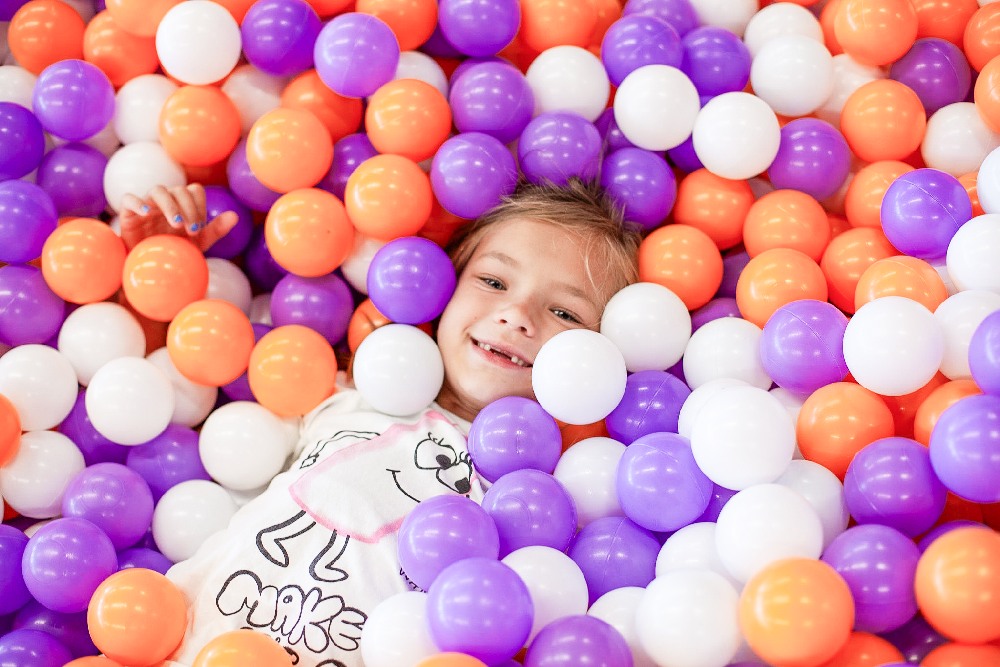
The physical layout at Fun Play World runs on zones — a design choice that means children at different ages and energy levels find their own level within the same space rather than competing for the same equipment. The climbing structures are substantial: multi-level, with real challenge at the upper sections. Slides. Open floor space. The ceiling height is generous — the space doesn't feel cramped when it fills up, which matters during a holiday week when visitor numbers run higher than a regular Tuesday.
Soft flooring throughout. No bare concrete under the structures, which is a detail parents notice immediately and that matters specifically for the two-year-old end of the age range where falls are frequent and expected. The toddler areas are genuinely designed for that developmental stage rather than being a scaled-down version of the older-kid equipment.
The adult seating runs across multiple sight lines. Parents who are sitting down can see the full play area — not just the section directly in front of them. During a Passover week when extended family is often visiting, and grandparents or aunts and uncles are along for the day, this matters. Adults who aren't actively chasing children can sit and actually see what's happening.
Pricing for Open Play: $35 for the first child per two-hour session, $25 for a second sibling, $20 for a third. Two adults included per family at no extra cost. Additional adults are $15. The monthly membership — $200 — is worth considering for families who find themselves coming in multiple times during Passover week and then continuing through the spring.
Birthday packages are available year-round, and April birthdays — which are common given the spring timing — often land right in or near Passover week. The Basic package starts at $1,800, Adventure at $2,300, Ultimate at $2,700, VIP at $5,700. An 18% service fee applies to all events and covers the team's prep, setup, and breakdown. Final balance due five days before the event; a 40% deposit secures the date. Passover week and the weeks immediately surrounding it are busy for birthday bookings — families who want an April date should reach out early.
FAQ
-
For toddlers and children under three, the most effective approach is sensory and short. A small seder plate at child height with real items to touch and taste. Songs with movement. The afikomen hide. A brief, illustrated haggadah read before the seder starts rather than during. At this age, the goal is exposure to the physical objects and sounds of the holiday rather than participation in the full narrative.
-
Yes — Open Play runs on its regular schedule throughout Passover week. Weekdays from 10 AM, Sundays from 9 AM. Walk-ins are welcome for regular Open Play sessions. Birthday parties and private events require advance booking.
-
For school-age children who've aged out of the craft-table approach, the options that hold tend to be physically active or socially oriented. Park and beach visits. Day trips to museums. Indoor play if the afternoon is hot. Cooking Passover desserts together has consistent cross-age appeal because it has a tangible result and older children can take on real cooking responsibility rather than decorating jobs.
-
April is a busy birthday month at both the Los Angeles and Santa Monica locations. Families should aim for two to four weeks minimum, sooner for weekend dates. A 40% non-refundable deposit holds the date. All events include an 18% service fee. The balance is due five days prior to the event.
-
For large family groups, the birthday party format — which includes private use of the party room alongside access to the play area — works better than standard Open Play. Packages starting at $1,800 accommodate group sizes that don't fit comfortably into a walk-in session. For families who just want to come as a normal extended group, the Open Play pricing structure covers the family unit with additional adults at $15 each.
-
The afternoons in Los Angeles in April can push warm enough that outdoor play becomes uncomfortable, especially for younger children. Indoor options — play spaces, museums, movies for older kids — handle the mid-afternoon gap reliably. Fun Play World's two-hour session structure is designed for exactly this kind of afternoon anchor: long enough to fully engage children, short enough to leave time for the rest of the day.