
Large Group Activities for Preschoolers in Los Angeles — What Works When the Numbers Get Big
This isn't an organizational problem. It's a developmental one. Preschool-age children between three and five years old are at a stage where they can navigate small social groups with some competence. They can share attention, wait a turn, manage basic conflict. But the larger the group, the more those skills are taxed — the more noise there is to process, the more bodies to read, the more competition for space and attention. Activities that require children to self-regulate in a large group need to be designed around that reality rather than against it.
What follows is a practical look at what actually functions for large groups of preschoolers in Los Angeles — from the developmental logic behind the activity choices to the specific venues and formats that serve this age and scale well.
Large Group Activities for Preschoolers and What the Group Size Actually Changes
Large group activities for preschoolers operate on different principles than small group activities, and the gap is larger than it appears on paper. The most important variable is noise — not just the volume, but the type. A group of twenty three-year-olds generates a specific quality of sound that is physically stimulating to every child in it. Some children respond to that stimulation with increased energy and excitement. Others get overwhelmed and shut down, or find a corner, or start crying without an obvious trigger.
Activities that work for large groups of preschoolers are the ones that either channel the energy of that environment or create enough physical space that children can self-select their level of stimulation. This is why open-floor physical play formats consistently outperform structured circle activities at this scale. When fifteen children are expected to sit and watch something together, nine of them are managing the impulse to move. When those same children have a play structure with multiple entry points, they spread across it and each finds a version of the activity that fits their current state.
The research on large group dynamics in early childhood settings consistently points to this: large group activity for preschoolers works best when the environment provides structure rather than the adult providing it. The room does the work. The materials define the activity. The adult's role shifts from director to support.
Preschool Large Group Activity Ideas That Work Without a Staff of Ten
Preschool large group activity ideas that are genuinely functional — not theoretically sound but practically workable — share a few characteristics that experienced educators identify quickly. The setup is simple enough that children can engage within thirty seconds of arrival. The activity can be abandoned and re-entered without consequence. And different children can do it at different levels simultaneously.
Music-based large group activities for preschool hold well across a wide ability range. Simple call-and-response songs, movement songs, drumming with household objects — these activities don't require individual mastery, they allow partial participation, and the shared rhythm creates a kind of social cohesion that structured games often fail to produce. The child who doesn't know the words still moves. The child who wants to sing louder can. The energy self-regulates through the activity rather than requiring adult management.
Outdoor relay-style games — running between two points, passing something simple, any format where children take turns without waiting very long — work for this age in large groups better than games with complex rules. The rule should be expressible in one sentence. The turn should take less than thirty seconds. And there should be enough activity going on that children who drift out and back in don't feel they've missed something irreversible.
Large group activities preschool educators in Los Angeles deploy most consistently during field trips and events are the ones that use physical space as the primary variable. A large room or outdoor area where children can spread out, find their own level, and participate at their own pace produces better outcomes than a tightly organized format that assumes all children will move through the same activity at the same time.
Large Group Activities for Preschoolers Indoors When Weather Closes the Outdoor Option
Large group activities for preschoolers indoors carry a specific set of design requirements. The space needs to be large enough that fifteen or twenty children can move without constantly colliding. The floor surface needs to be forgiving. And the activity design needs to allow self-directed movement rather than requiring every child to be in one place at one time.
Los Angeles gives families and educators an extended outdoor season, but summer afternoons, occasional rainy weeks, and the times when heat pushes the outdoor temperature past comfortable for young children all create demand for quality indoor large group options. The alternatives — a community center gym, a rental space with cleared floors, a well-designed indoor playground — each have their place depending on the specific group and the occasion.
Indoor spaces that handle large groups of preschoolers well are, honestly, rarer than they should be in a city this size. Most indoor venues optimized for children are scaled for small groups — a party room that fits twelve comfortably becomes chaotic at eighteen. The physical spaces that work for genuine large groups require either significant open floor area or the kind of structured zone design that lets children spread across different activity areas simultaneously.
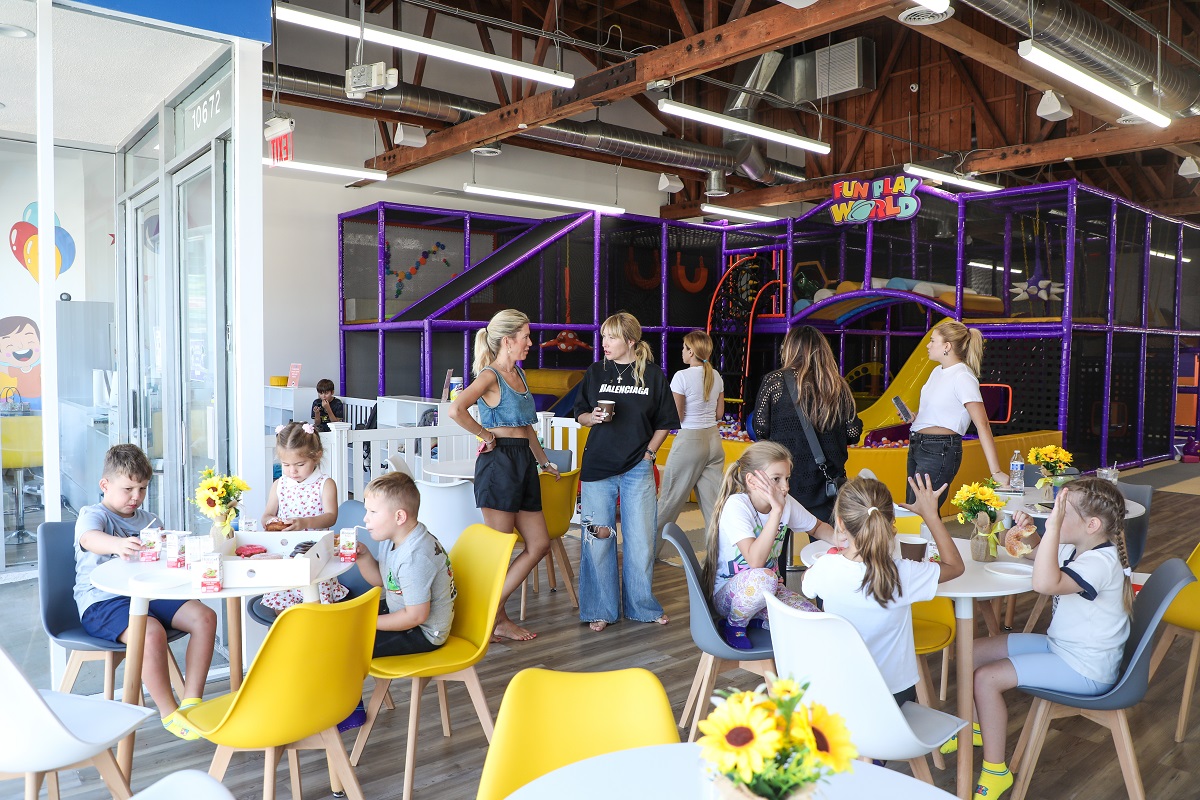
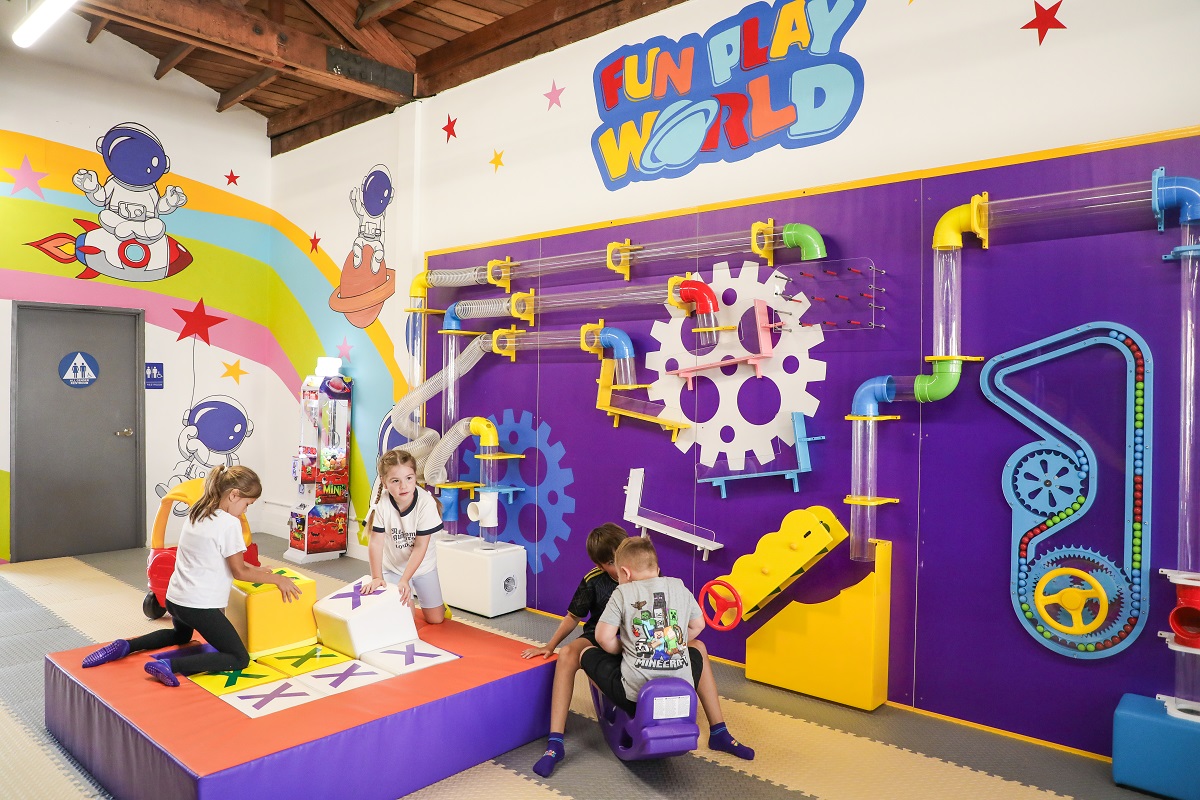
Fun Play World at 10672 West Pico Blvd in Los Angeles and at 828 Pico Blvd in Santa Monica handles this through a combination of multi-level structures and distinct floor zones. When twenty children arrive for a birthday party event, they don't converge on a single piece of equipment — they distribute across the floor naturally, some going high on the climbing structure, some moving through the lower zones, some circling back to the entry area. The space absorbs the group rather than concentrating it.
Large Group Activity Ideas for Preschoolers Around Los Angeles
Large group activity ideas for preschoolers that work specifically in the Los Angeles context draw from a wider range of venue types than most cities offer. The city has outdoor spaces that support large group visits for most of the year, a range of indoor venues for the hotter months, and a concentration of family-specific programming that reflects the density of young families in neighborhoods like the westside, Pico-Robertson, and Santa Monica.
Outdoor spaces that handle large preschool groups well include the grassy areas at parks like Pan Pacific, Griffith Park's picnic zones, and the wide lawns in the Santa Monica city parks. The key is enough open space that children can run without immediately reaching the boundary and turning back, and enough visual containment that caregivers can track the group without constant repositioning.
For organized group events — school field trips, birthday party groups, family reunion visits — the indoor play venue is increasingly the default in Los Angeles because it solves the weather and supervision variables simultaneously. The space is contained. The temperature is controlled. Children can't exit independently. And the equipment is designed to keep children engaged without requiring adult direction of each individual child.
Benefits of large group activities in preschool are well-documented in early childhood education research: children develop social skills like turn-taking, shared attention, and group navigation that one-on-one interactions don't fully build. They observe how other children use materials and structures. They negotiate spontaneously over equipment and space. These skills are foundational for the group learning environments of kindergarten and beyond, and large group play experiences in the preschool years provide genuine developmental value beyond the obvious fun.

Things To Do With a Large Group of Preschoolers for Birthdays and Special Events
Things to do with a large group of preschoolers when the occasion is a birthday party or a school celebration is a different planning problem than the regular Tuesday afternoon with a playgroup. The numbers are higher — fifteen to twenty-five children is typical for a birthday in this age range. The adults are less familiar with each other than in a regular playgroup. The children have different relationships to the birthday child, which means the social dynamics are more variable than a classroom group. And there's a timeline — the party has a start, a cake moment, and an end.
Group-scale birthday events at indoor play venues solve several of these variables simultaneously. The physical environment handles the supervision load by containing the group and providing enough equipment that children can self-direct. The venue's team manages transitions — play to party room to cake to play again — so the hosting parent isn't running logistics while trying to be present for their child's party. And the activity itself is already there, built into the structure, requiring no setup or explanation.
We've run a lot of large group birthday events at Fun Play World, and what we consistently observe is that the first few minutes after children arrive are the most instructive. A large group of preschoolers who don't all know each other walks in, looks at the play structures, and within ninety seconds has self-organized into smaller clusters that each find their own corner. The social work happens without adult facilitation, because the space gives it somewhere to go.
The party room separate from the open play area is what makes the birthday structure work at this scale. Without that separation, gathering twenty children from an active play session for cake is a ten-minute exercise in herding. With it, the transition has a clear destination and the party has a shape.
Los Angeles and the Group Visit Options Families Actually Use
Los Angeles families navigating large group preschool visits — whether for birthday parties, school events, or organized playgroups — tend to develop opinions quickly about which venues handle the specific demands of this age and scale.
The common feedback from parents who've run large group birthday events in Los Angeles is that the space needs to be bigger than it looks in the photos. Indoor play venues that look spacious in marketing imagery can feel cramped when twenty children arrive at once. The measurement that matters isn't total square footage — it's whether the layout creates natural distribution or creates a single point of congestion.
Large group preschool birthday events in the Santa Monica and westside neighborhoods have consistently high demand for venues that combine active play with a separate party space. The families in these neighborhoods are typically managing significant coordination — children coming from different preschools, parents who don't all know each other, a range of dietary needs and ages within the guests. Venues that handle the logistics provide genuine value, not just space.
Fun Play World's birthday packages are built around this reality. Basic starts at $1,800, Adventure at $2,300, Ultimate at $2,700, VIP at $5,700. The VIP level is the full-coordination option — food, setup, dedicated staff, breakdown. The lower packages provide the essential structure while families bring their own details. An 18% service fee applies to all events, covering the team's coordination work before, during, and after. A 40% deposit holds the date.
LA Families and the Birthday Party Scale Question
The birthday party question in LA has a specific version that large groups create. How many children is "normal" for a preschool birthday in Los Angeles? The honest answer is that the numbers tend to be larger here than in many other cities — class sizes at private preschools run higher, families are more socially networked, and the culture around children's birthday parties in certain LA neighborhoods has calibrated toward an event with a guest list rather than a small gathering.
Twenty children for a four-year-old's birthday is not unusual. Twenty-five is not rare. That scale requires a venue that has actually thought about what twenty-five preschoolers do when they arrive in the same space at the same time.
The zone design at Fun Play World — multi-level climbing, lower activity sections, the separation of the party room from the play floor — was built with this in mind. The play area accommodates the active phase without requiring rotation management. The party room holds the gathering phase without the children losing their place in the active play. The transition between the two is managed by the team rather than falling to the hosting parent.
For LA families who want to see the space before committing to a birthday booking, Open Play sessions run weekdays from 10 AM and Sundays from 9 AM at both the Los Angeles and Santa Monica locations. First child is $35 for two hours, $25 for a second sibling, $20 for a third. Two adults per family are included. Walk-ins are welcome. The monthly membership runs $200 for families who find themselves visiting consistently.
FAQ
-
Open Play works well for family groups and small gatherings — up to around eight to ten children comfortably within a single family session. For larger groups — twelve children and up, or groups where children aren't from a single family unit — the birthday party format with private party room access is the right structure. It provides dedicated space, staff coordination, and a timeline that Open Play doesn't.
-
The structured play floor is the primary activity — children this age don't need organized games imposed on them. The multi-level climbing structure, the different zones, and the open floor space handle the active phase entirely. The party room handles the gathering phase for cake and food. The sequence — active play, transition to room, cake, optional return to play — is built into how birthday events run without requiring the hosting family to manage it.
-
The space is designed with parent visibility as a priority — seating allows adults to watch across the full play floor from multiple positions. For birthday party events, the venue's team is present through the full event and coordinates the major transitions. The zone design means children naturally distribute across the space rather than converging on a single area, which makes observation manageable for a normal adult-to-child ratio.
-
Packages scale by level — Basic, Adventure, Ultimate, and VIP each cover different guest counts. The maximum guest count varies by package. The team can walk through current capacity guidelines when you reach out about booking. Booking early is important for larger parties, particularly weekend dates and summer months when demand runs highest.
-
First-time large group visits work smoothest when children arrive together rather than staggered over twenty minutes, and when adults position themselves across the floor rather than clustering near the entrance. Non-slip socks are required for the play area and are available for purchase at both locations. The first ten minutes are usually the most chaotic — children orient, the group spreads out, and the activity self-organizes quickly once each child finds a structure they want to be on.