
Crescent Bay Park Santa Monica — What This 1911 Coastal Spot Gives Families That Newer Parks Don't
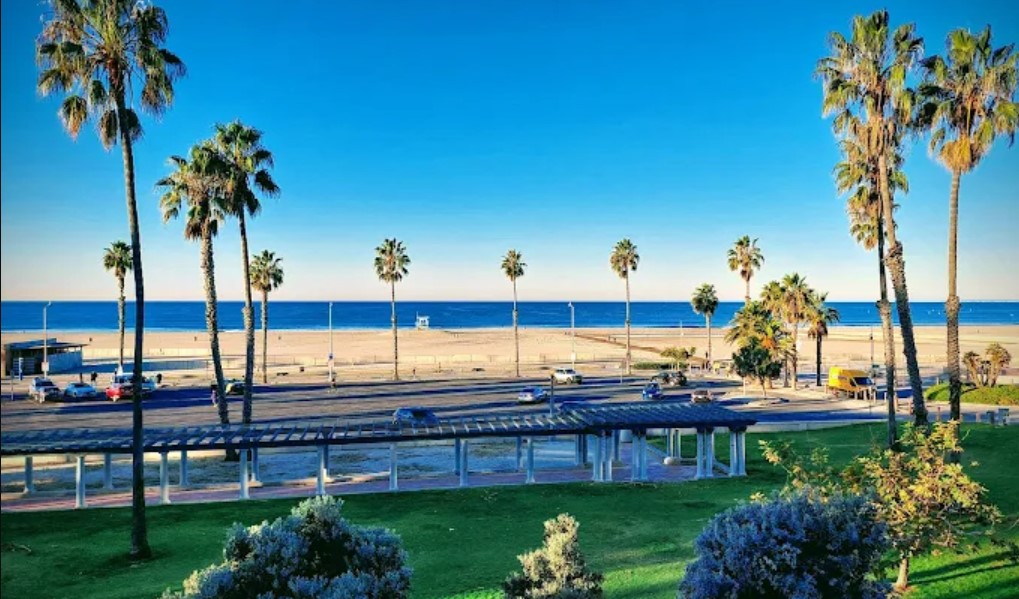
She was right, though. You do feel it. Something slower. The park sits on Ocean Avenue between Bay and Bicknell Streets, just south of the Pier's noise and energy, and it operates at a completely different frequency. Two levels, a gazebo on the upper lawn, a pergola below, the sound of the ocean more present than the sound of traffic. My older one ran straight to the upper railing. My younger one found a bench in the sun and sat down without being asked. That almost never happens.
The history came later, and it made the place mean more.
Crescent Bay Park Santa Monica CA — Layout, Levels, and What's Actually Here
Crescent bay park Santa Monica CA is at 2000 Ocean Ave, Santa Monica, CA 90405 — south of the Pier, between Bay and Bicknell Streets on the west side of Ocean Avenue. The park covers 2.27 acres and has been a public space since 1911, making it one of the older parks on the westside. Carl F. Schader donated the land to the city in 1910 with specific conditions: it had to remain a public park, include a bandstand and a sun parlor, and have a concrete sidewalk. The pergola on the lower level is the sun parlor he stipulated. It's still there.
The layout divides into two levels along a retaining wall. The upper level has the gazebo, benches along the grass, and views that run clear over the beach path and out to the water. Panoramic isn't an exaggeration here — you see the horizon without anything blocking it. The lower level holds the pergola and more grass area, slightly more sheltered from the wind that picks up along the bluff in the afternoon.
There's a playground area with swings and some basic gymnastics-style equipment — not a large installation, but enough for younger children who need to move while adults sit. Restrooms are on-site, accessible from the beach side. And the beach itself is one short flight of stairs down from the lower level, which means the park functions as an elevated staging area for the beach rather than a destination that competes with it.
Hours run from 6 AM to 11 PM daily. No admission. Dogs welcome on a leash.
Crescent Bay Parking and Why the Timing Decision Matters
Crescent bay parking is the single most variable part of planning a visit here. Ocean Avenue runs metered parking on both sides, and the blocks immediately north and south of the park hold some of the more contested street parking in Santa Monica during summer and holiday weekends. The beach parking lot at the base of the bluff handles overflow and is the most reliable option if you're driving, though it fills early.
The practical advice, honestly, is to arrive before 9 AM on weekends if you're driving. By 10 AM the crescent bay parking situation on Ocean Avenue has usually resolved itself into whatever combination of luck and circling the block you're willing to accept. By noon in summer it's a different exercise entirely — the kind that takes twenty minutes and ends somewhere two blocks east on a residential street with a one-hour limit.
Families who live within cycling distance of the Ocean Park neighborhood tend to use the park on bikes, which removes the crescent bay parking question from the equation entirely. The beach path runs directly below the park and connects to the broader coastal bike route in both directions. On Saturday mornings, cycling to the park and then to the beach and then back through Main Street is a full morning without ever dealing with a parking meter.
Public transit reaches the park via the Big Blue Bus — lines 1 and R7 both serve the Ocean Avenue corridor. For families who don't want to build their morning around parking, this option works without the ten-minute search.
Crescent Bay Park Santa Monica and the History That Changes How You See It
Crescent bay park Santa Monica holds a piece of Los Angeles history that isn't advertised at the entrance and isn't obvious when you first arrive. The stretch of beach below the park — Bay Street Beach — was known as "The Inkwell" during the era of racial segregation in California. When the public beaches along the Santa Monica coastline were effectively closed to Black beachgoers through social and legal pressure, this beach became one of the primary places where African American families from Los Angeles could go to the water without hostility.
It was a community space in the fullest sense. The beach and park served as a gathering place for a generation of Black Angelenos who built entire social and cultural rituals around it during decades when access to most of the California coast was a daily negotiation with racism. Musicians, writers, athletes, families with children — the Inkwell had a character shaped by that specific history of reclamation.
In 2008, the City of Santa Monica erected a monument at Bay Street and Oceanfront Walk officially recognizing this. The plaque is there, at the base of the park's stairs. It's worth a few minutes of your time, and worth explaining to children who are old enough to hear it.
I didn't know any of this the first time I sat on the upper lawn and watched my children run across the grass. Knowing it now changes the weight of the place — not in a heavy direction, but in the direction of something being more real than it looked. A park that has meant something specific to people over a long time carries that in its atmosphere, even when you can't quite name it.
Crescent Bay Park and the Specific Things It Does Well for Families
Crescent bay park works for families across a range of what-do-you-need-today scenarios. The upper lawn is wide and flat enough for blankets, lunches, and children who need space to run without consequence. The gazebo provides shade that the California coastal sun makes genuinely welcome between 11 AM and 2 PM. The lower pergola area is slightly cooler on warm afternoons due to the retaining wall behind it, which is a physical detail I noticed on the third visit when we arrived late and needed somewhere to sit that wasn't direct sun.
The beach access is the real advantage for families visiting for the first time. The park isn't just near the beach — it's structurally connected to it, with the lower level opening directly toward the beach path stairs. So a family can use the park as base camp: adults and younger children stay on the lawn while an older child tests the water, everyone reassembles at the pergola, the next rotation goes down. That back-and-forth works because the transitions are short. Nothing is more than a minute from the upper lawn to the waterline.
The swings and basic playground equipment hold younger children when the beach isn't the right call — sand in a toddler's shoes at the wrong moment can derail an afternoon faster than most parents anticipate — and the two-level layout gives different family members genuinely different experiences in the same visit. Someone reads on the upper lawn. Someone plays below. Someone looks out at the water.
Los Angeles Families and the Westside Coastal Routine Built Around Parks Like This
Los Angeles families who live on the westside develop a park rotation that reflects the city's geography more than its formal amenities. Crescent bay park in Los Angeles terms is a neighborhood park — it doesn't have the scale or the programming of Palisades Park to the north, and it doesn't have the facilities of Douglas Park inland, but what it has is specificity of atmosphere and a coastal position that the inland parks simply don't possess.
Families in Ocean Park, Venice, Culver City, and Mar Vista return to this park not because it has the longest list of facilities but because it consistently delivers the particular morning they need. That quiet upper lawn. The horizon without buildings. The sense of being above the beach but still part of it.
The ritual of the crescent bay park Santa Monica visit looks different at different life stages. Young families with strollers use it for the flat lawn and the shade. Families with school-age children use the beach access. Older children who don't need playground equipment use it as the gathering point before a longer beach day. The park adapts without changing, which is what the best public spaces do.
When families from further east — Culver City, the Pico corridor, even Beverlywood — make the drive to crescent bay park Santa Monica CA, they're usually making the drive for the full westside morning: park, beach, Main Street, coffee, home. The park is the opening note of that sequence, not the full day. Knowing that makes it easier to plan around.
LA Afternoons After Crescent Bay Park and Where the Day Goes Next
LA afternoons have a specific problem that the morning usually doesn't. The marine layer burns off. The sun gets direct. Children who were happily digging in sand at 9 AM are visibly struggling by 1 PM, and the beach trip that felt infinite in the morning has a clear ending point that arrives sooner than anyone expected.
The move from outdoor to indoor in the early afternoon is not giving up on the day. It's managing the day correctly, which is something LA families learn through experience rather than instruction. The parks are better in the morning. The indoor options earn their place in the afternoon. Getting the sequence right is the difference between a weekend that felt full and a weekend that ended with someone in tears in a parking lot.
Fun Play World at 828 Pico Blvd in Santa Monica is on the Pico corridor — less than ten minutes from Crescent Bay Park for families already on the westside. The drive is short, and if you're already planning to get lunch on Main Street or Pico before the afternoon, the timing works naturally. Beach, park, lunch, play space. The children get two different kinds of movement, the adults get to sit somewhere that doesn't require sunscreen reapplication, and the day holds together into the evening.
The indoor play space here runs on a zone-based structure — different levels, different challenge scales, soft flooring throughout. Children who arrive carrying beach energy move straight to the climbing structures. The transition from the park to the play space is fast, not because we rush it, but because the space is ready for children in exactly the state that a morning at Crescent Bay Park leaves them: tired but not finished, warm, social, still wanting to go.
Open Play runs weekdays from 10 AM and Sundays from 9 AM. First child is $35 for two hours, $25 for a second sibling, $20 for a third. Two adults per family included. Walk-in sessions don't need a reservation. The monthly membership at $200 makes the outdoor-indoor pattern a standing part of the week rather than a per-visit decision.
Birthday parties follow a different track — packages start at $1,800 for Basic, $2,300 for Adventure, $2,700 for Ultimate, and $5,700 for VIP. The team handles setup, food at the relevant package levels, and breakdown. A 40% deposit holds the date, with the final balance due five days before the event. An 18% service fee applies to all events.
Why the Santa Monica Pico Corridor Makes a Full Day Possible
The geography of the westside creates a natural daily circuit that crescent bay park Santa Monica sits at one end of. The park is on Ocean Avenue. The beach is below it. Main Street runs two blocks east with cafes and restaurants that absorb families between morning activity and afternoon plans. Pico Boulevard runs parallel to that, connecting the beach end of Santa Monica to the Pico-Robertson neighborhood and the broader westside in the direction of Los Angeles.
Families who use this circuit — park, beach, lunch, indoor play, home — tend to report the best days. Not because any single element is exceptional in isolation but because the sequence holds together without friction. You're not driving across the city between activities. You're moving along a mile-wide corridor that was built for this kind of family day whether it was intentional or not.
The crescent bay park Santa Monica CA visit is the beginning of that circuit when it's working well. And when children have been fully present in the morning — really played, really run, really looked at the water — they carry that into the rest of the day in a way that keeps the afternoon from collapsing into restlessness or conflict. The morning at the park does the work that makes the afternoon possible. That's what it's always done for this neighborhood, in one form or another, since 1911.
FAQ
-
The park was established in 1911 after Carl F. Schader donated the land to Santa Monica in 1910, stipulating it remain public and include the pergola that still stands. Its larger historical significance connects to Bay Street Beach — known as "The Inkwell" — one of the few accessible beach areas for African American Angelenos during the Jim Crow era. A monument recognizing this history was erected at Bay Street and Oceanfront Walk in 2008. The park is part of the Bay Street Beach Historic District.
-
Street parking on Ocean Avenue runs on meters, and both the residential blocks near the park and the beach parking lot below fill quickly on weekends and holidays. Arriving before 9 AM is the practical standard for families who want to drive. After 10 AM on busy weekends, expect to spend time finding a space. Cycling and public transit via the Big Blue Bus are the alternatives that remove parking from the equation entirely.
-
The upper level has the gazebo, benches, and a wide grass lawn with unobstructed ocean views. The lower level holds the pergola — the original sun parlor from the park's founding — and additional grass area. A playground with swings and basic equipment sits within the park. The beach is accessible via stairs from the lower level, making the park a functional staging point for beach visits.
-
The Santa Monica location at 828 Pico Blvd is under ten minutes from the park. Open Play sessions are walk-in, starting at 10 AM on weekdays and 9 AM on Sundays. Families who spend the morning at the park and beach typically arrive at the play space around midday or early afternoon when the outdoor heat and the children's appetite for sand have both reached their limits. The two-hour session structure covers the afternoon gap cleanly.
-
The open lawn and beach access make the park flexible across most ages — toddlers through adults all find something that works. The playground area is sized for younger children. The beach access serves older children who want more independent movement. Families with mixed ages generally find the two-level layout gives different people genuinely different experiences in the same visit without anyone waiting around for the others.